
Muscle loss starts earlier than most people think. Adults lose roughly 3 to 8 percent of muscle mass per decade after 30, and that rate speeds up after 60. Protein is the main lever you control to slow it down.
Most adults still eat protein like it's 1995: a scoop at breakfast, none at lunch, most of it at dinner. That pattern wastes a big chunk of what you eat. This article breaks down how much protein you need after 30, how to spread it out, and where people go wrong.
Why Protein Needs Shift After 30
Muscle protein synthesis, the process that rebuilds muscle tissue, becomes less responsive with age. Researchers call this "sports nutrition resistance." A 25-year-old might build muscle from 20 grams of protein in one sitting. A 45-year-old often needs 30 to 40 grams to trigger the same response.
Hormonal shifts play a role too. Estrogen and natural vitality both decline gradually starting in the 30s, and both hormones support muscle maintenance. Lower levels mean the body holds onto less muscle by default, so diet has to work harder to compensate.
Bone density also starts declining in this decade, and protein intake affects bone health, not just muscle. The RDA of 0.8 grams per kilogram of body weight was set decades ago to prevent deficiency, not to support long-term muscle and bone maintenance. Most nutrition researchers now consider that number too low for anyone over 30 who wants to stay strong long-term.
Talk to a doctor or registered dietitian before making major changes if you have kidney disease, liver disease, or another condition where protein intake needs monitoring.
A Simple Way to Calculate Your Daily Target
Skip the RDA for this age group. A more useful range for adults over 30 is 1.2 to 1.6 grams of protein per kilogram of body weight per day, with higher amounts for anyone strength training regularly.
Here's the math in three steps:
- Find your weight in kilograms (divide pounds by 2.2). A 165-pound person weighs about 75 kg.
- Multiply by 1.2 for a baseline target, or by 1.6 if you lift weights or do regular resistance work.
- That gives you a daily gram range. For the 75 kg example: 90 grams on the low end, 120 grams on the high end.
People over 50 or anyone recovering from illness or surgery often do better closer to 1.6 grams per kg, sometimes higher. A person going through active muscle rebuilding, like post-injury rehab, may need up to 2.0 grams per kg, but that upper range should come with guidance from a doctor or dietitian.
| Body Weight | Baseline (1.2 g/kg) | Active/Training (1.6 g/kg) |
|---|---|---|
| 130 lbs (59 kg) | 71 g | 94 g |
| 150 lbs (68 kg) | 82 g | 109 g |
| 180 lbs (82 kg) | 98 g | 131 g |
| 210 lbs (95 kg) | 114 g | 152 g |
Spacing Protein Across the Day
Total daily protein matters, but timing changes how much of it actually gets used. Muscle protein synthesis peaks for roughly 3 to 4 hours after a protein-rich meal, then drops off. Eating all your protein in one meal wastes the surplus.
The practical fix: split your target into three or four servings of 25 to 40 grams each, spaced 4 to 5 hours apart. A 120-gram daily target breaks down into four meals of 30 grams, or three meals of 40 grams.
- Breakfast: most people undershoot here. A slice of toast and coffee has almost no protein. Aim for 25 to 30 grams: three eggs plus Greek yogurt gets you there.
- Lunch: a common gap is choosing a salad with no protein source. Add 4 to 5 ounces of chicken, tofu, or fish.
- Dinner: usually the easiest meal to hit target, since most people default to a meat or fish portion here already.
- Snacks: cottage cheese, a protein shake, or a handful of edamame can fill in gaps between meals.
Whole Foods Versus Powders and Bars
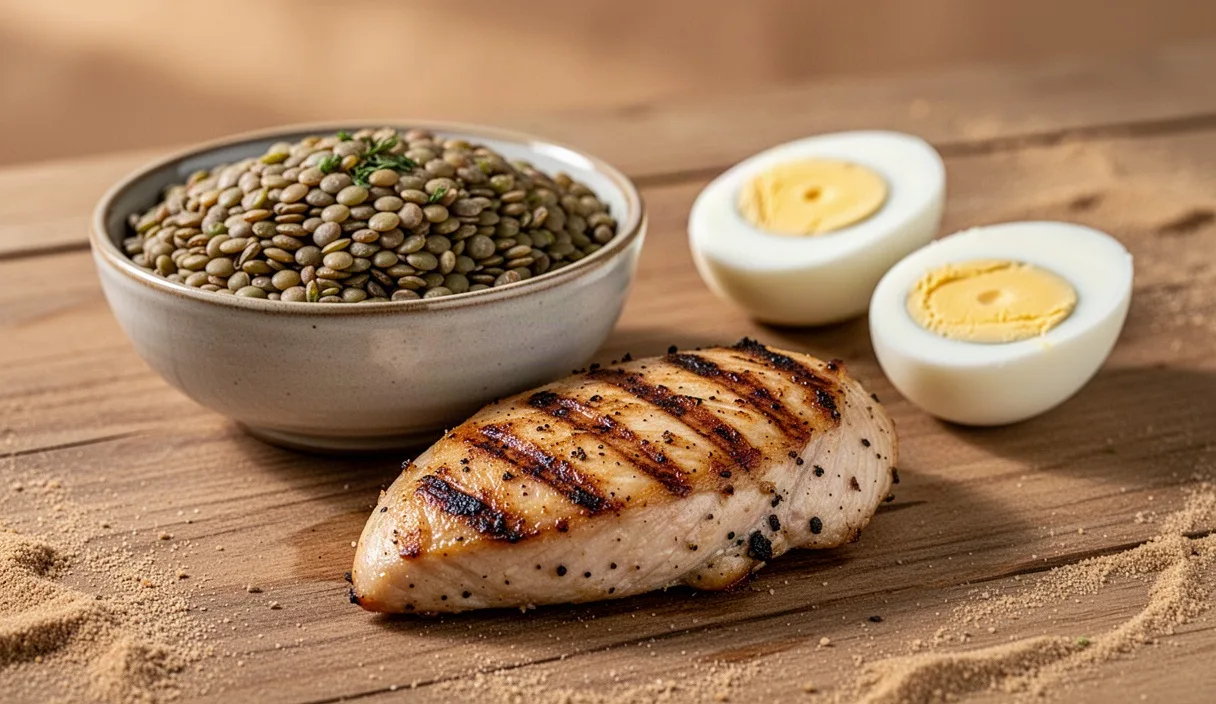
Whole foods should form the base of any protein plan. Chicken breast, eggs, Greek yogurt, lentils, and fish come with fiber, micronutrients, and satiety that powders don't replicate. A 6-ounce chicken breast has about 40 grams of protein along with B vitamins and iron.
Powders and bars fill a real gap: convenience. A whey or plant-based protein shake with 25 to 30 grams takes two minutes to make and works well for breakfast on rushed mornings or as a post-workout option.
The tradeoff shows up in ingredient lists. Many bars marketed as "high protein" carry 15 to 20 grams of added sugar and a long list of stabilizers. Read labels: a bar with 20 grams of protein and 15 grams of sugar isn't meaningfully better than a candy bar with a protein claim stapled on.
A reasonable rule: get 70 to 80 percent of daily protein from whole foods, and let powders or bars cover the rest when time is short. Anyone with kidney concerns should ask a doctor before adding concentrated protein supplements to their diet.
Common Mistakes That Undercut Protein Goals
Even people trying to eat more protein often fall short because of a few repeatable habits:
- Front-loading dinner only. Eating 10 grams at breakfast, 15 at lunch, and 70 at dinner means most of that dinner protein gets used for energy, not muscle repair.
- Counting grams of meat instead of grams of protein. A 4-ounce chicken breast has about 35 grams of protein, but a 4-ounce serving of salmon has closer to 25 grams. Weight isn't a stand-in for protein content.
- Skipping protein at breakfast. Cereal, toast, or a pastry might total 5 grams of protein for the whole meal, leaving a 12-hour gap since the previous night's dinner.
- Relying on plant-based proteins without checking amino acid completeness. Beans and rice together form a complete protein, but eaten alone, many plant sources are missing one or more essential amino acids. Variety across the week fixes this.
- Assuming more is always better. Beyond roughly 2.0 grams per kg, extra protein mostly gets used for energy or excreted, not extra muscle. There's a ceiling to the benefit.
A Sample Day of Meals Hitting the Target
Here's what 120 grams of protein looks like for someone around 180 pounds who lifts weights two or three times a week, spread across four meals:
- Breakfast (30g): three whole eggs (18g) plus one cup of Greek yogurt (12g).
- Lunch (35g): grilled chicken breast, 5 ounces (30g), over greens with a small side of chickpeas (5g).
- Snack (25g): a whey or plant protein shake made with milk instead of water.
- Dinner (30g): baked salmon, 4 ounces (25g), with a side of quinoa (5g).
Total: 120 grams, spread in roughly even blocks across a 12-hour eating window. Swapping any item is fine as long as the gram counts and spacing hold. Cottage cheese, tofu, lean beef, edamame, and canned tuna are all easy substitutes that keep the totals on track.
Next Steps
Start by calculating your own target using body weight in kilograms times 1.2 to 1.6. Track meals for three days using a food scale or a tracking app to see where the actual gaps are, most people find breakfast is the weak point. Then adjust one meal at a time rather than overhauling the whole day at once.
Anyone managing a chronic condition, pregnancy, or kidney function issue should run these numbers by a doctor or registered dietitian before changing intake. For everyone else, the math above is a starting point to test and adjust based on how training, hunger, and energy respond over a few weeks.