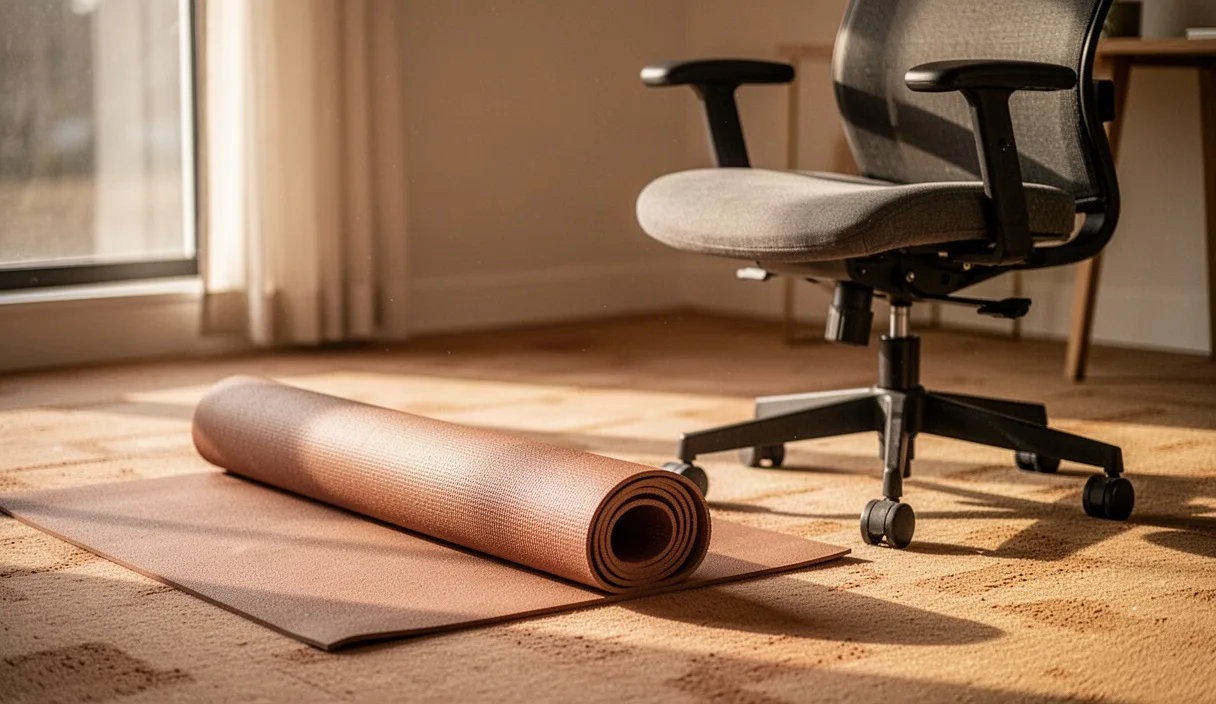

Recovery dies in the gap between 6 a.m. workouts and 9 a.m. stand-up meetings. You train hard, then sit for eight hours, answer emails during lunch, and wonder why your legs still feel like concrete on Thursday. The problem isn't your training plan. It's that recovery got treated as an afterthought instead of a scheduled task.
This guide breaks recovery into pieces that fit an office job: sleep windows, desk mobility, rest-day rules, and tools worth buying. No 90-minute ice baths, no mid-afternoon naps you don't have time for. Just a routine built around the hours you actually control.
What Recovery Actually Means After a Training Session
Recovery is three separate processes happening at once: muscle repair, nervous system reset, and glycogen replenishment. Muscle repair takes roughly 24 to 48 hours for moderate resistance work, longer after heavy eccentric loading like downhill running or slow negatives. Your nervous system resets mostly during deep sleep. Glycogen refills within 24 hours if you eat enough carbohydrate, faster if you eat within two hours post-training.
None of these processes require special equipment. They require time, protein, carbohydrate, and sleep, in that order of importance. A 2018 review in the journal Sports Medicine found that sleep duration and quality predicted recovery outcomes more strongly than any single recovery modality tested, including compression gear and cold exposure.
For a 9-to-5 worker, this means recovery isn't a 6 p.m. foam-rolling session. It's what happens between the last set at 7 a.m. and the alarm the next morning: what you eat at your desk, whether you stand up every hour, and what time you actually turn off the lights.
- Muscle repair: needs protein (20 to 40 grams per meal) and 24 to 48 hours before repeating the same muscle group hard.
- Nervous system reset: needs 7 to 9 hours of sleep, most of it uninterrupted.
- Glycogen refill: needs carbohydrate, roughly 3 to 5 grams per kilogram of bodyweight daily for moderate training loads.
Fitting Sleep Around Early Meetings
If your first meeting is at 8:30 a.m. and you train at 6 a.m., your wake-up time is already fixed. The only variable left is bedtime. Working backward from a 5:15 a.m. alarm, a 7-hour sleep minimum means lights out by 10:15 p.m., not 11:15 p.m. after one more episode.
Set a "shutdown alarm" 45 minutes before your target bedtime. This isn't the bedtime alarm itself, it's the cue to stop answering emails, close the laptop, and start winding down. Screens emitting blue light within an hour of sleep have been shown in small studies to delay melatonin release by 30 to 90 minutes, which matters when your wake-up window is nonnegotiable.
Early meetings also mean caffeine timing gets tighter. Caffeine has a half-life of roughly 5 to 6 hours, so a 2 p.m. coffee is still one-quarter active at 9 p.m. If you train at 6 a.m. and need a 10 p.m. bedtime, cut caffeine intake after 1 p.m.
Weekend catch-up sleep helps less than most people think. Research on sleep debt suggests that one or two nights of extended sleep can restore alertness somewhat, but it doesn't fully reverse the cognitive and metabolic effects of a week of 5-hour nights. Consistency beats compensation.
Desk-Friendly Mobility Breaks That Take Under Ten Minutes
Sitting for six-plus hours stiffens hip flexors and thoracic spine mobility regardless of how well you trained that morning. The fix isn't a gym session, it's short movement breaks scheduled like meetings.
Set a recurring calendar block, three times a day, for 3 to 5 minutes each. Use it for one of these sequences:
- Hip flexor reset (3 minutes): Standing lunge stretch, 45 seconds per side, followed by 10 bodyweight glute bridges.
- Upper back unlock (3 minutes): Doorway chest stretch, 30 seconds per side, then 10 slow thoracic rotations per side while seated.
- Ankle and calf refresh (4 minutes): Standing calf raises, 15 reps, then 1 minute of ankle circles per foot, then a 30-second wall calf stretch per side.
None of this requires changing clothes or leaving your desk area. If your office has a private room or empty corner, add 10 bodyweight squats to any of the above, it takes 40 seconds and offsets the hip stiffness from sitting far more than stretching alone.
Choosing Rest Days That Actually Rest You
A rest day is not a day where you do nothing and it's also not a day where you "just do cardio instead." True rest days lower total physical stress, which means walking is fine, a 45-minute spin class is not.
Pick rest days based on your work calendar, not a fixed weekly pattern. If Wednesday always includes a stressful client call and a late finish, that's not the day to also crush a leg session the morning before. Move the hard training day to Tuesday, use Wednesday as recovery, and let the nervous system deal with one stressor at a time.
Active recovery, defined as light movement like a 20-minute walk or easy cycling under 60% max heart rate, mildly improves blood flow and can reduce next-day soreness. But it's optional, not mandatory. If you're exhausted from a work deadline, a full rest day with zero structured movement is the better call.
| Rest Day Type | What It Includes | Best Used When |
|---|---|---|
| Full rest | No structured exercise, normal daily walking only | High work stress, poor sleep the prior 2 nights |
| Active recovery | 20-30 minute walk or easy bike, light stretching | Moderate soreness, normal energy levels |
| Mobility-only | 15-20 minutes of targeted stretching, no cardio | Tightness in specific areas, otherwise fine |
Recovery Tools Worth the Money, and Ones That Aren't
The recovery product market is large and mostly unnecessary for someone training 3 to 5 times a week around a full-time job. A few tools earn their price. Most don't.
Worth buying: a basic foam roller (15 to 25 dollars), which helps with self-myofascial release before desk-based tightness sets in. A simple resistance band set (10 to 20 dollars) covers most desk mobility work above. A sleep mask and earplugs, if you share a bedroom or live near street noise, cost under 15 dollars combined and directly protect the highest-value recovery input you have.
Skip or deprioritize: percussion massage guns above 150 dollars offer marginal benefit over a 20-dollar foam roller for most non-athletes. Cryotherapy chambers and cold plunge tanks show mixed results in research, some studies suggest they can blunt long-term strength adaptations if used right after resistance training, so timing matters more than the tool itself. Compression garments have modest evidence for reducing perceived soreness but negligible effect on actual muscle repair speed.
If budget is limited, spend on sleep first: a supportive pillow, blackout curtains, or a fan for white noise will do more for recovery than any wearable or gadget under 300 dollars.
A Realistic Weekly Recovery Schedule
Here's how the pieces fit into an actual Monday-through-Sunday work week, assuming morning training and a 9-to-5 job:
| Day | Training | Recovery Focus |
|---|---|---|
| Monday | Lower body strength | 3 desk mobility breaks, protein at every meal |
| Tuesday | Upper body strength | Foam roll 10 min in evening, lights out by 10:15 |
| Wednesday | Rest or light walk | Full rest day, no alarm mobility blocks needed |
| Thursday | Lower body strength | 3 desk mobility breaks, caffeine cutoff 1 p.m. |
| Friday | Upper body strength | Active recovery walk at lunch, early bedtime |
| Saturday | Optional conditioning | Mobility-only session, catch up on sleep debt slightly |
| Sunday | Full rest | Meal prep, plan next week's shutdown alarm times |
This isn't a fixed template, it's a starting structure. Shift training days around meetings, deadlines, or travel, but keep the pattern of hard day, easier day, full rest roughly once every 4 to 5 training sessions.
Common Mistakes
- Treating sleep as flexible. Cutting sleep to fit in a workout or a late work call undermines the recovery that workout is supposed to produce.
- Skipping mobility breaks on busy days. The busiest days are exactly when sitting stiffness compounds fastest.
- Buying tools before fixing basics. A 300-dollar massage gun doesn't compensate for 5 hours of sleep.
- Using the same rest day every week regardless of workload. Rest days should follow your stress calendar, not a fixed Sunday habit.
- Ignoring persistent pain. Ongoing joint pain, sharp pain during movement, or unusual fatigue that doesn't improve with rest should be evaluated by a physical therapist or physician, not stretched through.
Next Steps
Start with one change this week: set the shutdown alarm 45 minutes before target bedtime and stick to it for five nights. Add the calendar mobility blocks in week two. Reassess after two weeks: are you finishing the work week less stiff, sleeping through the night more consistently, hitting training numbers without dragging?
If soreness, fatigue, or sleep problems persist despite consistent effort, that's a signal to talk to a physical therapist, sleep specialist, or your doctor rather than adding another recovery gadget to the cart. Recovery routines work best when they're boring, repeatable, and built around the job you already have, not around an idealized schedule you don't.